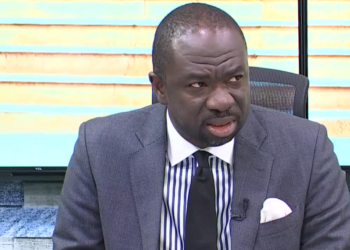

Former Finance Minister Dr Mohammed Amin Adam has described the government’s $10 billion New Economy Programme as “dead on arrival”, questioning its financing arrangements and the government’s ability to mobilise enough revenue to implement the proposed projects.
He said the government’s revenue collection record raised doubts about its capacity to finance the programme, particularly after failing to meet its revenue targets in 2026.
Speaking on the Asaase Breakfast Show on Friday, 13 November, Dr Amin Adam argued that the government could not rely on anticipated revenue increases to finance an ambitious economic programme when its existing revenue mobilisation efforts were falling short.
The New Economy Programme is expected to attract $10 billion in investments over four years, with the Finance Minister indicating that the private sector would play a leading role while government provides infrastructure, strategic support and macroeconomic stability.
However, Dr Amin Adam questioned whether the $10 billion represented a firm financial commitment from government or an investment target expected to be mobilised from both public and private sources.
He argued that the government’s earlier attempt to secure private sector financing for the 24-hour economy programme had not attracted the expected response.
“The government has moved. It doesn’t believe in the private sector anymore because the private sector did not respond to its call to invest in the 24-hour economy,” he said.
He recalled that the 24-hour economy was designed as a $4 billion programme, with government expected to contribute between $300 million and $400 million, while the private sector was to provide the remaining $3.6 billion.
According to him, the lack of private sector participation had compelled the government to assume a greater financing responsibility under the new programme.
“This New Economy, the government now wants to foot the entire bill. Ten billion dollars for four years. The government wants to foot the entire bill, and we know how they intend to fund it,” he said.
Dr Amin Adam said the government’s decision to reduce its primary surplus target from 1.5 per cent of GDP to 0.5 per cent of GDP was intended to create fiscal space for the programme.
He, however, stressed that fiscal space did not automatically translate into new money available to the government.
“Fiscal space doesn’t mean new money. It only means that you have to collect the money through taxes or generate money through taxes,” he said.
He argued that the success of the New Economy Programme would therefore depend largely on the government’s ability to improve revenue mobilisation.
Dr Amin Adam cited the 2026 revenue performance, saying the government had collected GHC167.2 billion between January and October, below the target of GH¢170 billion for the period.
He said the government had also failed to meet its revenue target in the previous year, making it difficult to understand how it intended to finance a substantially larger economic programme.
“Even in this year, 2026, the total tax revenue target hasn’t been met. They collected, from January to October, GHC167.2 billion, which is below the target of GHC170 billion,” he said.
“Last year, they didn’t meet the revenue target. If you now want to implement an ambitious programme like this, which is based on unpredictable revenue, then this New Economy is dead on arrival.”
The former Finance Minister also questioned the Finance Minister’s assurance that the government would not borrow to finance the New Economy Programme.
He pointed to the 2027 budget’s provision for GH¢85 billion in domestic borrowing, asking whether the government was excluding domestic borrowing from its definition of borrowing.
“In this same budget, the minister says they will borrow GH¢85 billion from the domestic market as part of the funding,” he said.
He added: “When the Minister says they will not borrow to fund this programme, and then the budget mentions that they will borrow GHC85 billion from the domestic market, is the Minister saying that borrowing is borrowing only when it comes from external sources?”
Dr Amin Adam maintained that the government’s revenue performance and financing arrangements did not provide sufficient assurance that the New Economy Programme could be implemented as announced.
He said the government needed to explain how it intended to raise the required funds before making employment and investment promises to Ghanaians.