
The National Council for Curriculum and Assessment (NaCCA) has withdrawn printed copies of a Senior High School (SHS) teacher manual after acknowledging that certain content on “Gender Identity” in the Year 2 Physical Education and Health (Elective) Teacher Manual did not align with Ghanaian culture, norms, and values.
A revised version of the manual, reflecting national values and biological understanding, has now been released.
The move comes amid allegations by Member of Parliament for Assin South, Rev. John Ntim Fordjour, that the government was promoting an LGBTQ agenda through teacher manuals and other teaching and learning materials (TLMs) in schools.
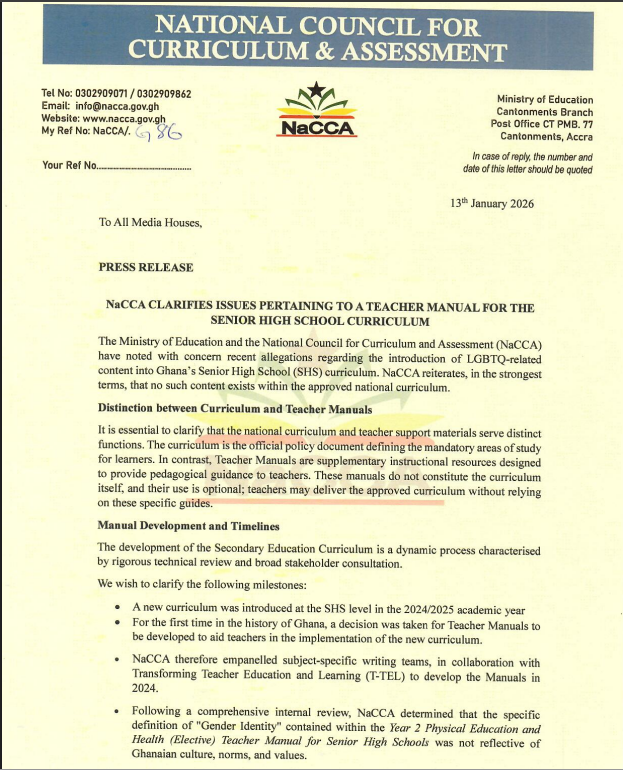
The controversy centred on a specific definition within the Year 2 Physical Education and Health (Elective) Teacher Manual, a supplementary guide developed in 2024 to aid teachers implementing the new SHS curriculum introduced last academic year.
In a statement issued the same day, NaCCA clarified the distinction between the official SHS curriculum and teacher support materials, stressing that the curriculum itself contains no LGBTQ-related content. The council noted that teacher manuals are supplementary resources meant to guide educators, and their use is optional.
“The Government of Ghana has no intention to promote, endorse, or introduce LGBTQ content at any level of the educational system,” the council said. “Our curriculum remains firmly anchored in the socio-cultural fabric of Ghana, constitutional principles, and child-centred development goals.”
NaCCA confirmed that steps are being taken to remove the old manuals from circulation, and that all future updates will be made available digitally.
The council urged the public and stakeholders to base discussions on verified facts and reaffirmed its commitment to transparency, responsiveness, and maintaining educational resources that reflect Ghanaian national values.
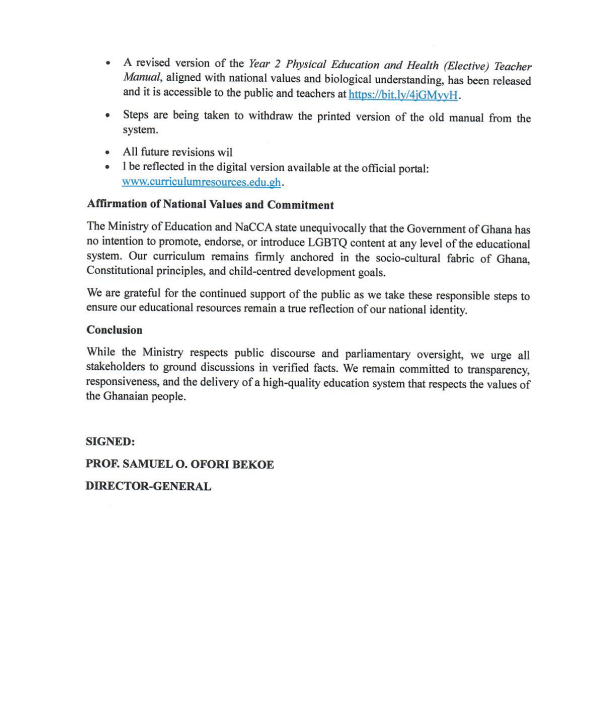
Director-General Professor Samuel O. Ofori-Bekoe emphasised the council’s dedication to delivering a high-quality education system aligned with the country’s cultural and constitutional principles.